
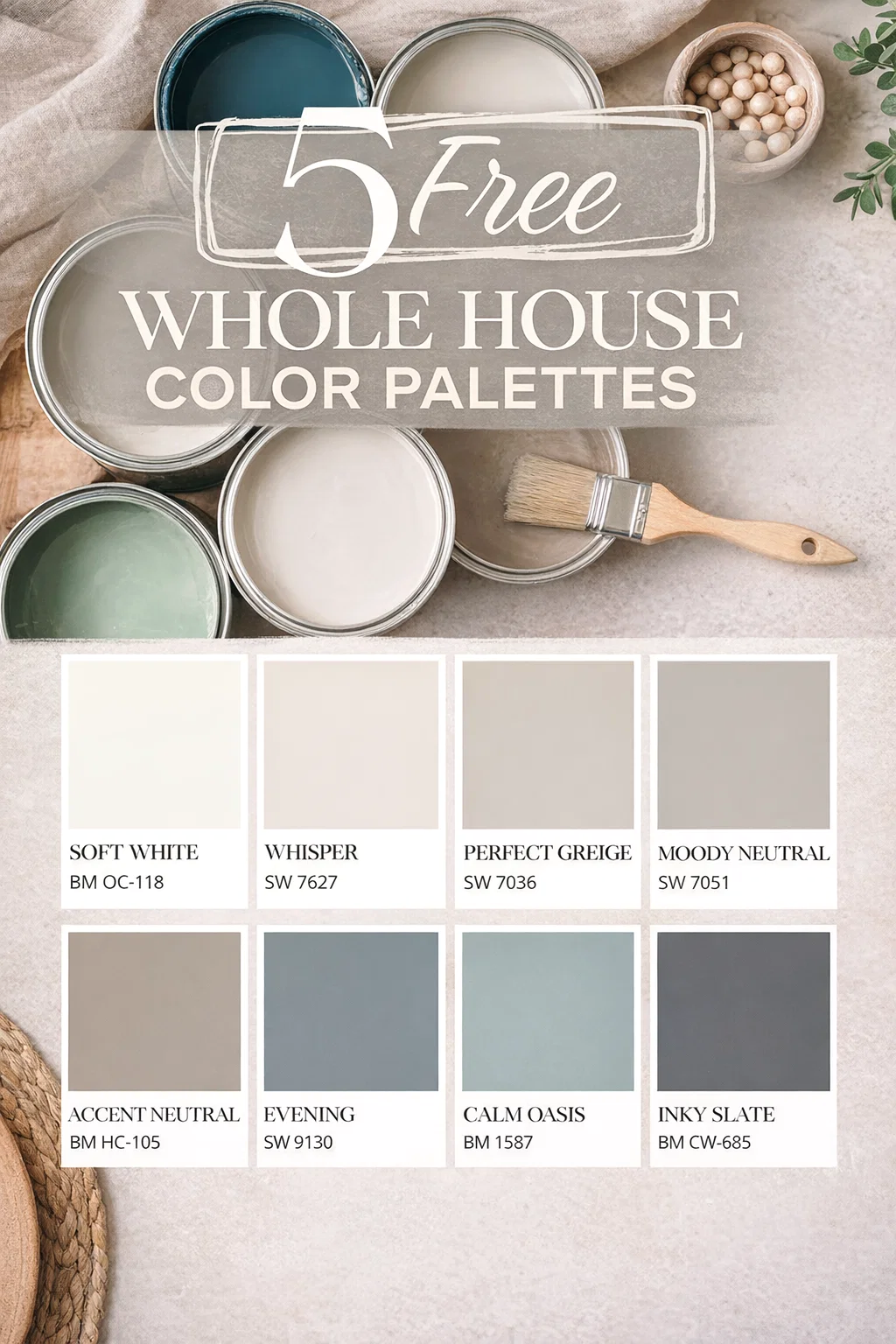
Finding the perfect color scheme for an entire home is often the most daunting task of any interior design project. Many homeowners find themselves staring at hundreds of tiny paint swatches, wondering how a kitchen color will transition into the hallway or if the bedroom hue will clash with the living room furniture. The secret to a professional looking home lies in a curated whole house color palette. By selecting a coordinated range of colors that share similar undertones, you can create a sense of flow and intentionality that makes every room feel connected. The palette featured in the image provides a masterclass in this approach, blending soft whites, versatile greiges, and deep, moody accents to create a balanced environment.
Understanding the Power of a Cohesive Color Story
A cohesive color story does more than just make a house look pretty. It provides a psychological sense of calm and order. When you move from a light, airy living room into a slightly darker, more intimate dining area that shares the same base tones, your brain perceives a continuous environment rather than a series of disjointed boxes. This visual continuity is especially important in modern open concept homes where multiple functional areas are visible at the same time.
The beauty of the featured palette is its versatility. It relies on neutrals that act as a canvas for your life. Neutrals are not just beige or gray; they are complex mixtures of pigments that react differently to light throughout the day. By using a whole house palette, you ensure that the light in your south facing bedroom and the shadows in your north facing office are both accounted for within a singular, harmonious framework.
The Role of Neutrals in Modern Design
Neutrals have evolved significantly over the last decade. We have moved away from the stark, cold grays of the early 2010s and the heavy, yellowed beiges of the 90s. Today, the focus is on “greige” and “complex neutrals.” These colors, such as Perfect Greige and Moody Neutral seen in our guide, offer the warmth of beige with the sophistication of gray. They are incredibly forgiving, hiding minor wall imperfections while providing a backdrop that complements almost any wood tone or fabric choice.
Deep Dive into the Primary Palette Shades
To successfully implement this look, it is helpful to break down how each specific color functions within a home. Every palette needs a “workhorse” color, an “anchor” color, and an “accent” color. Let us look at how these Benjamin Moore and Sherwin Williams favorites work together.
The Foundation: Soft White and Whisper
Every home needs a reliable white. Soft White (BM OC-118) and Whisper (SW 7627) are excellent choices for ceilings, trim, and doors. However, they also shine as primary wall colors in smaller rooms or spaces with limited natural light. Soft White has a hint of warmth that prevents it from looking like a clinical gallery, while Whisper offers a creamy, barely there depth that feels exceptionally cozy in a nursery or a reading nook.
The Transitions: Perfect Greige and Moody Neutral
These are your transition colors. Perfect Greige (SW 7036) is a designer favorite because it maintains its integrity under various lighting conditions. It is ideal for hallways and entryways because it connects the brighter rooms to the darker ones. Moody Neutral (SW 7051) takes it a step further, offering a bit more pigment. This shade works beautifully in a master suite or a home office where you want a bit more “hug” from your walls without committing to a dark cave like feeling.
Adding Depth with Accent and Evening Tones
A palette consisting only of light colors can sometimes feel flat. To create a high end, architectural look, you must introduce contrast. This is where colors like Accent Neutral (BM HC-105) and Evening (SW 9130) come into play. These are sophisticated, mid tone shades that provide a resting place for the eye.
- Accent Neutral: This Benjamin Moore classic is part of the Historical Collection. It has a timeless quality that works perfectly for built in shelving or a kitchen island.
- Evening: This is a stunning earthy green gray. It brings a touch of nature indoors and is a great choice for a mudroom or a powder bath where you want to make a statement.
Creating Atmosphere with Calm Oasis and Inky Slate
The final layer of a great house palette involves the “mood makers.” These are the colors that define the character of a specific room. Calm Oasis (BM 1587) and Inky Slate (BM CW-685) provide the necessary drama to elevate a home from standard to spectacular.
Designing with Calm Oasis
Calm Oasis is a muted, watery blue gray. It is the perfect antidote to a stressful day. Using this in a bathroom or a laundry room can transform a utilitarian space into a spa like retreat. Because it has gray undertones, it feels sophisticated rather than juvenile, making it a safe choice for adult spaces.
The Impact of Inky Slate
Do not be afraid of the dark. Inky Slate is a powerful, deep charcoal that can completely redefine a space. While it might feel intimidating to paint an entire room this dark, it works wonders on accent walls, window sashes, or even a fireplace mantel. It provides a sharp contrast against Soft White trim, creating a crisp, modern aesthetic that feels incredibly expensive.
How to Test Your Colors Like a Pro
Before you buy five gallons of paint, you must test your selections. Lighting is the single most important factor in how a color appears. A greige that looks warm and inviting in a sunny showroom might look muddy and green in a basement with fluorescent bulbs.
- Use Large Samples: Small swatches are misleading. Use peel and stick samples or paint large pieces of poster board so you can move them around the room.
- Check Different Times of Day: Observe your samples in the morning light, the harsh afternoon sun, and under your artificial lights at night.
- Consider Your Flooring: Your floor is the “fifth wall.” Ensure your paint colors complement the undertones of your hardwood, carpet, or tile.
Practical Tips for a DIY Paint Transformation
Once you have settled on your whole house palette, the execution is key. Painting is one of the most cost effective ways to increase your home value, but only if it is done correctly. Preparation is 90 percent of the job. Ensure you are filling holes, sanding rough spots, and using high quality painter’s tape to get those crisp lines between your new Inky Slate accent wall and your Soft White ceiling.
When working with a palette like this, consider the “60-30-10” rule. Use your foundation color (like Soft White) for 60 percent of the space, your secondary transition color (like Perfect Greige) for 30 percent, and your boldest accent (like Inky Slate or Calm Oasis) for the final 10 percent. This ratio ensures balance and prevents any one color from overwhelming the home.
Beyond the Walls: Coordinating Your Decor
A whole house color palette should extend beyond the paint on your walls. Use these same tones to inform your choice of rugs, throw pillows, and even hardware. For example, if you have used Calm Oasis in your bedroom, bring that same shade into your living room through a decorative vase or the pattern in a rug. This creates “visual echoes” throughout the house, reinforcing the sense of harmony you have worked so hard to create.
Metallic finishes also play a role. Warm tones like Perfect Greige look stunning with brass or gold hardware, while cooler tones like Inky Slate and Calm Oasis pair beautifully with matte black or polished chrome. By keeping your hardware finishes consistent or complementary across the house, you further solidify the cohesive design.
Conclusion: Your Path to a Harmonious Home
Designing a whole house color palette is about more than just following trends; it is about creating a space that reflects your personality and supports your lifestyle. The combination of Benjamin Moore and Sherwin Williams shades explored here offers a foolproof roadmap for anyone looking to achieve a professional, coordinated look. From the airy brightness of Soft White to the grounded depth of Inky Slate, these colors provide a framework for a home that feels curated, intentional, and timeless.
Remember that paint is just the beginning. It is the backdrop against which your life unfolds. By choosing a cohesive palette, you eliminate the visual clutter of clashing rooms and allow the beauty of your furniture, your art, and your family to take center stage. Grab some samples, start experimenting with the light in your home, and enjoy the process of transforming your living space into a unified sanctuary. Your dream home is only a few brushstrokes away.